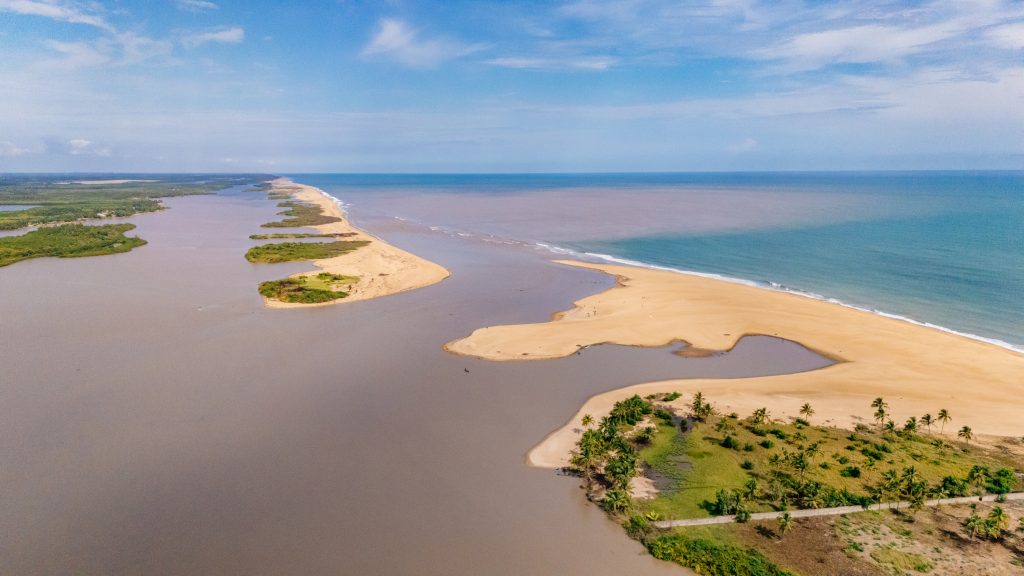

La Bouche du Roy
At the mouth of the Mono River, between Lake Ahémé, the coastal lagoons, and the Atlantic Ocean, the Bouche du Roy offers a vast landscape where the river’s freshwater mixes with seawater, set amid a mosaic of mangroves, marshes, beaches, sandbars, lagoons, and channels. A marine protected area and the heart of the UNESCO-recognized Mono Transboundary Biosphere Reserve, the site is home to remarkable biodiversity: birds, fish, crustaceans, reptiles, sea turtles, dolphins, whales, and manatees. It is also a wetland of international importance under the Ramsar Convention.
La boca do rio at the Bouche du Roy
As early as the late 16th century, the communities living along the shores began engaging in fishing, navigation, and the exploitation of natural resources, in close interaction with the hydrological cycles and lagoon ecosystems.
The name “Bouche du Roy” likely stems from a mistranslation into French of the Portuguese expression “a boca do rio”—“the mouth of the river.” Some sources suggest a Spanish origin, “la boca del río”, which has the same meaning. This name reflects the strategic role that this river mouth once played in trade between the coastal kingdoms and European sailors.
Today, the Bouche du Roy is recognized for its ecological, scenic, and scientific richness, and serves as a prime area for the conservation of coastal ecosystems and adaptation to climate change.
Where the Mono River flows into the Atlantic, Benin holds one of its most beautiful secrets.

The experience
Hop aboard a pirogue and let yourself be guided through the channels, among the mangroves. Before reaching the mouth of the river, discover Salt Island and Bird Island, then enter the mangrove channel, where motorboats are prohibited. Watch the birds and, with a little luck, the catfish moving through the mangrove mudflats. Finally, reach the sandbar, that narrow strip of land where the river meets the ocean: on one side, calm water; on the other, the rolling waves of the Atlantic. Just a few steps are all it takes to go from one world to the other.
Take the time to talk with the local communities. They have depended on this water for centuries and know its ways better than anyone. Depending on the season, you’ll appreciate the ecological richness of this wetland and the dedicated efforts to preserve it—here, nature conservation isn’t just talk; it’s a matter of survival.

Access conditions
- When to go Every day
- Recommended duration 2 to 3 hours
- Entrance Depending on activities
Access by pirogue from the riverside villages; half-day or full-day excursion. A local guide is highly recommended.
Life jackets must be worn at all times during the crossing. Unsupervised swimming: where the river meets the ocean, strong currents develop that vary with the tides, and swimming is not recommended on the ocean side. Children must be supervised at all times on the sandbar.
The site does not have a first-aid station. Your guide will report to the maritime police at the 10 January pier before boarding and will provide the officers on duty with the phone numbers to call in case of an emergency. If there is no guide present, you must report this yourself before launching the boat.
An early start is recommended for birdwatching. What to bring: a hat, sunscreen, a bottle of water, sandals or shoes that can get wet.
Tailor-made stay
Contact Bénin Tours, the official Beninese tour operator dedicated to discovering the Benin destination.
Contact Bénin Tours (opens in a new tab, you'll be redirected to benintours.bj)